videogamesartist.com

visit videogamesartist.com
Showing posts with label sightseeing. Show all posts

2007-11-25

Hakone

Last week we made a short trip to Hakone, a mountain area about an hour and a half by train West of Tokyo. In fall, it attracts lots of visitors like ourselves to admire the brightly coloured autumnal trees. Using the Hakone Freepass we were able to easily travel to and through the area using trains, buses, ferries, ropeways and cablecars.

Mount Fuji as seen from the ferry while crossing Lake Ashi.

At night we stayed at a traditional japanese hotel with private hot spring baths. We had a bathtub both inside and outside our room.

The next day we took a ropeway up to Owakudani, where we ate pitch black eggs boiled in the hot sulfuric volcano water. Each egg you eat is said to prolong your life by 7 years; I ate three.

The bright reds and yellows that the Japanese maple leaves turn are indeed spectacular.
Hakone is also the home of many modern art museums. We chose to visit the Hakone Open Air Museum, which features many sculptures by the likes of Henry Moore, Picasso and Jean DuBuffet (above).

2007-09-25

A day at the Sumo

Last week Monday we attended the sumo tournament at the Kokugikan, the sumo arena in Tokyo. It was the 9th day of the two-week tournament held each year in September.
The Kokugikan arena around noon. The bouts start from 9am, but most of the crowd arrives at 2:30pm when the professionals take the stage.
Referees are barefoot during the lower-ranked bouts.

The ritual foot stomping is said to increase strength and squash bad spirits.

The initial lunge.
One of the few short ceremonies held before the top ranking wrestlers start their bouts.

Companies that sponsor the prize money for this bout are allowed to advertise on these banners before the bout starts.

Many bouts are over in a matter of seconds, but in this one the two wrestlers were locked in a battle that seemed to last for minutes.


The final bout of the day followed by the "bow dance" closing ceremony.

2007-08-27

Koenji Awaodori dance festival


The summer festivals continue and this weekend we visited the Awaodori dance festival in Koenji, Tokyo. According to the official website it is the second largest Awaodori festival in the country, at which a staggering 12,000 dancers perform on two evenings. As expected, there were large crowds, but it wasn't too difficult to find a good spot to view the parade from, and the atmosphere was fantastic.


Saving the best for last:

2007-08-08

Matsuri in Asagaya

This weekend we visited a street festival in Asagaya. Asagaya has a quite long glass-covered shopping street that takes a good 10 minutes to traverse on a normal day. As you can see by the crowd below, this was no normal day! The entire length of the street was heavily decorated with lanterns, banners and large paper mache cartoon figures. There were a handful of videogame characters, but they were relatively poorly made compared to this pink bundle of joy.
This is a very common sight at a matsuri. Using a paper "net", kids try to scoop goldfish from a large tank to take home. The paper easily rips when wet, so they must continue to try using the edges of the paper.

Finally! I got to see some stag- and rhino beetles on sale. These wrestling beasts are summer pets for Japanese kids. Admittedly it's difficult to see, but there's a big one feeding at the front, just to the left of the metal ring.

Also on sale were this singing Long-horned Grasshopper, hermit crabs, white salamanders, turtles and crickets.

Of course no street festival is complete without excessive amounts of food. Here scallops and squid-on-a-stick are being sold.

2007-06-16

Happy Mascots in Kawagoe

Onions are usually associated with making people cry, but these can only put a smile on your face.
Local delicacy the sweet potato is more likely to scare off tourists with that grumpy face. Still, if you're ever in Kawagoe, I can recommend you try the sweet potato ice cream. It's purple and tasty.

These mochi-making mascots look none too happy. Presumably it becomes less fun if you have to do it all year round.

The one hundred million yen (ichi oku yen) note exists, is made of dried squid, edible, and will set you back only 350yen.
Usually in Japan you find people in bright coloured clothing either handing out tissues or shouting at passers-by outside mobile phone shops in order to promote their wares. Here, a trio of superhero ninja monkeys serve the same purpose.

I just love this antique. The frog is asking the rhino beetle car to let the turtle and caterpillar cross the road. Crawl safely.

2007-06-05

Kawagoe, "Little Edo"

On Sunday we made a day trip to Kawagoe, a small city about 40 minutes by train from Ikebukuro station in Tokyo. It's known as "Little Edo" for its many Edo-period (1603-1898) buildings that remain there. The main attractions include the Tokino Kane (Bell Tower), and a street lined with black clay-walled stores known as Kurazukuri. We visited one of them which now acts as a museum (entry 100yen) and which used to be a tabacco wholesaler's shop. Elsewhere in town there are some large temples, an utterly cute candy-store alley, several museums, and part of the former castle (below).
One of the temples, known as the Kitain, has 538 stone statues on its grounds. The panorama below shows most of them, click on the image for a closer view.
On the last visitor bus through the street with the clay-walled stores I made the video below, which gives a good impression of the street. Highly recommended for a quick and easy day trip from Tokyo.


Links: Koedo Kawagoe Tourist Association (English pages)
Next post: Happy Mascots spotted in Kawagoe!

2007-04-06

Hanami at night

Cherry blossom fever continues. Yesterday evening we went to see the cherry blossoms lit up along the Nogawa river. The event was started eleven years ago with the lighting up of a single tree.

Sakura along the Nogawa
Against a black sky, the white trees look even more surreal and make for a somewhat tricky camera subject...Click on any of the images for a larger view, or here to see a video.

Crowd pleaser
The lights are only set up for one night, and only three hours, so it draws quite a crowd. Police were on the scene to tell people to move along.

White trees black sky

2007-04-01

Hanami weekend

As this weekend was officially the best time to go look at the cherry blossoms this year, we decided to go visit one of the many sakura festivals held in the city. Going out to see the flowers actually has its own word for it: hanami, "hana" meaning flower, "mi" to look.
Click on the pictures below for a larger image.

Panorama of one of the sakura-lined streets surrounding a block in Akasaka, Tokyo.

While the skies may have been overcast all weekend, it was still a spectacular sight to see these white trees. For me, it was the first time to see it on such a scale. As we first entered the street, we were greeted by a blizzard of flower petals. I took of a video of it, but after putting it online it has been scaled down and recompressed, so much of the effect is lost.

So that's what they look like up close.

Some larger trees seen along the Zempukujigawa. These weren't even the largest around, just the more photogenic ones.

2007-03-15

Along the Zempukujigawa

Through Suginami runs the Zempukujigawa river, along which we cycled some last weekend. Part of the river is surrounded by the Zempukujigawa Green Belt, which consists of a number of parks and recreational areas.

Cherry blossoms are making headlines in the news again. A computer glitch at the Meteorological Agency supposedly was the cause of the incorrect forecasts of the "official" cherry blossom season. Just so you know, in Tokyo the blossoms are now expected to open around March 23 instead of the original prediction of March 18. This tree, and several others seemed happy with an earlier date, though.


The utterly cute Children's Traffic Park (1-22-13, Naritanishi, Suginami) looks like a great place for kids to learn to ride a bike and the traffic rules. Bicycles, tricycles and pedal cars can be rented and ridden around this miniature town, with low traffic signs and signals. There are even pedal cars for adults in which the very young kids can ride along. It wouldn't surprise me if the rental is free, but we didn't ask. There's also a playground in the park (and many more elsewhere along the river) and an old locomotive.


The Omiya Hachimangu shrine (2-3-1, Omiya, Suginami) is a fairly large shrine that is said to have been built [originally] sometime in the 8th-12th century. There's a fair margin of error for guessing the exact year. The grounds are also quite beautiful, and South of the main building are a large number of portable shrines on display. The sun was setting, so no great photos this time, but I'll certainly be back.

2007-01-05

An evening in Yokohama

The day before yesterday we made a short trip to Yokohama. We arrived in the late afternoon, looked around the shops a bit, and headed East to the Yokohama Passenger Terminal. We had seen it from a distance a few years ago, but decided to have a closer look this time. The simplest description for it is that it's a large futuristic pier for cruiseships with an enormous wooden, steel and grass landscape deck, but that doesn't do it justice. The photos below don't really give a good idea of the sheer size of it, either. I can recommend anyone visiting Yokohama to take the slight detour and go for a walk on this pier. You get to see some fantastic architecture up close and a great view of the Yokohama harbour front.

After darkness had completely fallen, we went ice skating at an outdoor rink next to the orange-lit warehouse-turned-shops in the top picture. Some, though not all, of the rental skates had flashing lights attached under the shoes which reacted to the skater's movement, lighting up the ice - a very nice effect. Although crowded (possibly because it was still in the New Year's 3-day holidays), the rink was a decent size and the price wasn't bad either. We concluded the evening with a ride on the Chrono Clock, the 5th largest ferris wheel in the world.

2006-12-18

Mochitsuki

Yesterday my father-in-law, an active member in the local community, took me to a local rice cake making event. The rice cake is called mochi, the traditional way of making it is called mochitsuki. About 80 people had turned up for this year's event, which took place outside a community center a few blocks away from our house. Mochitsuki involves pounding rice into paste using large wooden mallets, so it's fun for the whole family.

The rice is first steamed (not boiled) above fires. It is then put into a mortar, where it is first kneaded and subsequently pounded into a thick paste using big wooden mallets. The rice is kneaned first to stop the rice from flying about when it is pounded. While the rice is being pounded, another person wets and turns the rice between each hit. Although you're encouraged to keep a fairly high rhythm to this, I found it quite difficult to do so with the kind old lady sticking her hand in the mortar every time!

After the pounding it is cut and molded into shapes and is eaten with either sweet or savoury flavourings. I tried two sweet varieties (one in red bean sauce, the other with toasted soybean flour) and one savoury (mochi with fine chopped radish). Mochi is incredibly chewy so it took me ages to finish the portion I'd been given. I much preferred the sweet variety.

Traditionally mochi is food for the Japanese New Year. Because it can be kept for a very long time, it would be made just prior to the new year and could be consumed throughout the winter. It can be further prepared in many different ways. For example, it can be added to soup or small pieces of dried mochi can be deep fried to make a crispy snack.

After the mochitsuki, I was invited to join the organisers in a lunch with beer and shōchū, which is a kind of Japanese vodka that's quite nice to drink with hot water.

Later that (birth)day, I took the family out for dinner at an Izakaya (Japanese "tapas-bar").

Read more about Mochi on wikipedia.

2006-12-13

Inakaya

On Monday, my wife and I had something to celebrate, so on the advice of a friend of mine we went to Inakaya, a small restaurant in the heart of Roppongi. He strongly dislikes the area, so for him to recommend a place there it had to be pretty special.

The restaurant itself has only one table, around which on three sides sit all 25 or so guests. On the fourth side of the table sit two chefs in front of a grill and some other traditional cooking equipment. Fresh meat, seafood, tofu, vegetables and other foodstuffs are laid out in baskets over the table, which basically serves as the menu.

Each order you make is shouted out by the waiters and repeated in unison by the two chefs and all the other waiters present. A chef then grabs the required ingredients from the area in the middle and proceeds to prepare the order. When it is done, the dish is presented to you by the chef from where he's sitting using a long oar, while shouting the name of the dish. Bottles of beer and sake are also "handed" to you by these chefs, but certain dishes (sauces) and drinks are brought to you by the waiters.

Among other things, we tried dried stingray (which has a strong taste) and crispy bite-size crabs, which are eaten whole - and are delicious.
During the meal there was some additional entertainment in the form of a short ritual when the chefs are replaced, and when some rice cake was prepared, for which some younger guests were asked to help pound the rice.

The only downside to this restaurant is perhaps its price tag. While not immensely expensive for West European or American standards, it is so for Japanese. Most of the clientele is indeed foreign, so the waiters also speak English. The portions are of a good size and beautifully presented, and of course you pay for the service and atmosphere. All in all recommended if your wallet allows it.


Map and restaurant information can be found here at the Tokyo Food Page.

2006-12-08

Roppongi Hills

Roppongi is an area of Tokyo that's the home of many embasssies, foreign companies, foreign restaurants, The Hard Rock Cafe... I think you get picture. It also carries the reputation of being one of the sleaziest areas and in response to that there's been a recent surge in large property developments, the first being Roppongi Hills which opened in 2003. A few weeks ago I had to be in the area so decided to take a look.

The quite good looking Mori Tower is the center piece, which is surrounded by restaurants, an art museum, cinema, the offices of TV Asahi, and countless luxury shops predominantly owned by the big Italian fashion brands. For architecture-tourists I'd say the area is worth a look. (Left: a panorama photo put together quickly without proper stitching software).

While I was there, there was some sort of outdoor promotional exhibition by BMW. Aside from a few of their latest 4x4s, racing cars and motorcycles being on display, there were a few interactive exhibits to make it all a bit more fun. Visitors could have a go at playing a F1 game (I think the game was Grand Prix 3) from inside an "F1 car"; it wasn't particularly impressive but enough to warrant a queue of about a dozen people. Elsewhere there was a yacht racing simulator with a yacht-sized steering wheel. The graphics for the water, sunlight and surroundings looked pretty good for its purpose but the model and texture of the boat itself were downright shoddy.


Not far from Roppongi Hills the National Art Center Tokyo is nearing completion and is due to open January 21st, 2007. The building looks impressive enough from the outside, so I'm quite keen to have a look inside.

2006-11-28

Akiba Robot Fair 2006

Earlier this month, me and a friend went to the Akiba Robot Fair in Akihabara. Akihabara is also known as "Electric Town" and is famed for its enormous electronics shops. It has also evolved into a center for geek ("otaku") culture with its many games- and anime shops, and more recently the Maid Cafés. The last time I was in Akihabara I don't think these even existed, now you are greeted by a number of maids promoting their cafés as soon as you come out of the station (on a busy Saturday at least).

The robot fair itself, located in a shiny new building behind the station, featured robot football and battle events, build-your-own-robot workshops, special demonstrations and of course a display of various robots.


Click on the images below to see the videos I took at the fair.

A creepily realistic robot woman.

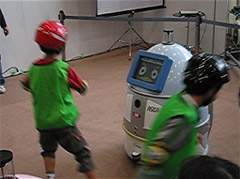
Kids confuse a penguin robot.

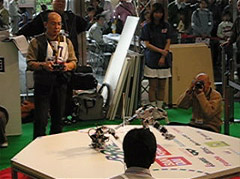
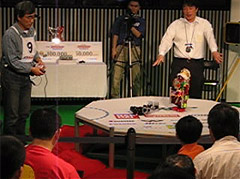
Robot Battle: Humiliation!

A typical Robot Battle.


You can read another blog post about the Akiba Robot Fair here.

2006-11-16

Autumn Fire Prevention Week

Yesterday was the last day of Autumn Fire Prevention Week in Japan. The week starts annually on November 9th, as a reminder to dial 11-9 in case of a fire. The local firestation (shoubousho) was open to the public on Sunday, and since it is literally a stone's throw from our house we decided to have a look.

A number of firefighting and rescue operations were on display or being demonstrated. We saw a demonstration of a portable defibrillator which talks the user through the steps on how to use it, firemen sliding a stretcher and themselves down a rope, and a fireman abseiling down the side of a building. Children could wield (water-based) fire extinguishers and watch animations -- from what I could see, it just looked like Pokemon to me, though. We saw a young child crying its eyes out after its parents had put it in an oversized fireman's outfit, and were trying to take a picture of it.
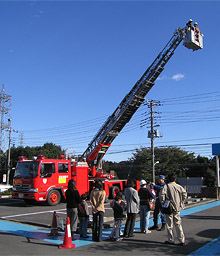
The highlight however was the chance to be lifted up an extending crane to about 30m high (shown here about halfway up).

For me, Autumn Fire Prevention Week has done its job - I've since had a look at the website of the
Tokyo Fire Department (English page) and know what to do in case of fire: run down the road to the shoubousho! Or dial 119.