videogamesartist.com

visit videogamesartist.com
Showing posts with label food. Show all posts

2007-11-25

Hakone

Last week we made a short trip to Hakone, a mountain area about an hour and a half by train West of Tokyo. In fall, it attracts lots of visitors like ourselves to admire the brightly coloured autumnal trees. Using the Hakone Freepass we were able to easily travel to and through the area using trains, buses, ferries, ropeways and cablecars.

Mount Fuji as seen from the ferry while crossing Lake Ashi.

At night we stayed at a traditional japanese hotel with private hot spring baths. We had a bathtub both inside and outside our room.

The next day we took a ropeway up to Owakudani, where we ate pitch black eggs boiled in the hot sulfuric volcano water. Each egg you eat is said to prolong your life by 7 years; I ate three.

The bright reds and yellows that the Japanese maple leaves turn are indeed spectacular.
Hakone is also the home of many modern art museums. We chose to visit the Hakone Open Air Museum, which features many sculptures by the likes of Henry Moore, Picasso and Jean DuBuffet (above).

2007-08-08

Matsuri in Asagaya

This weekend we visited a street festival in Asagaya. Asagaya has a quite long glass-covered shopping street that takes a good 10 minutes to traverse on a normal day. As you can see by the crowd below, this was no normal day! The entire length of the street was heavily decorated with lanterns, banners and large paper mache cartoon figures. There were a handful of videogame characters, but they were relatively poorly made compared to this pink bundle of joy.
This is a very common sight at a matsuri. Using a paper "net", kids try to scoop goldfish from a large tank to take home. The paper easily rips when wet, so they must continue to try using the edges of the paper.

Finally! I got to see some stag- and rhino beetles on sale. These wrestling beasts are summer pets for Japanese kids. Admittedly it's difficult to see, but there's a big one feeding at the front, just to the left of the metal ring.

Also on sale were this singing Long-horned Grasshopper, hermit crabs, white salamanders, turtles and crickets.

Of course no street festival is complete without excessive amounts of food. Here scallops and squid-on-a-stick are being sold.

2007-06-16

Happy Mascots in Kawagoe

Onions are usually associated with making people cry, but these can only put a smile on your face.
Local delicacy the sweet potato is more likely to scare off tourists with that grumpy face. Still, if you're ever in Kawagoe, I can recommend you try the sweet potato ice cream. It's purple and tasty.

These mochi-making mascots look none too happy. Presumably it becomes less fun if you have to do it all year round.

The one hundred million yen (ichi oku yen) note exists, is made of dried squid, edible, and will set you back only 350yen.
Usually in Japan you find people in bright coloured clothing either handing out tissues or shouting at passers-by outside mobile phone shops in order to promote their wares. Here, a trio of superhero ninja monkeys serve the same purpose.

I just love this antique. The frog is asking the rhino beetle car to let the turtle and caterpillar cross the road. Crawl safely.

2007-03-20

Happy Mascots: Random Encounters #7

Squid sweets
Squid smurf demonstrates the elasticity of this dried squid "sweet". It was in fact one of the most sour things I have ever eaten in my life.

beardy fellow
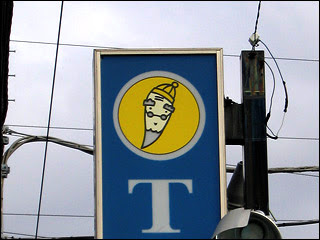
TV station TBS also builds homes - this beardy fellow appears to be the Happy Mascot for the homes division.

happy cigarette
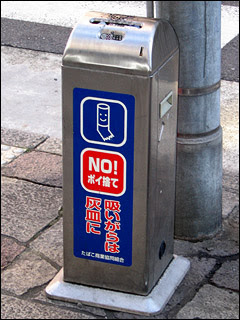
Even cigarette butts themselves prefer to be put in an ashtray than be thrown out onto the street.

2007-01-01

Happy New Year!

...or akemashite omedetou: "congratulations on the beginning of a New Year"!

New Year is one of the most important holidays in Japan. Like Christmas in the West, celebrations are a mixture of religion, visiting family, watching TV, gift giving and of course lots of food.

Following a tradition dating back to the Edo-period (17th-19th century), on New Year's Eve we ate Toshikoshi soba ("Going into the New Year" buckwheat noodles), and on New Year's Day we had Mochi. We didn't watch the yearly Kohaku Uta Gassen on TV, a 5-hour singing "contest" featuring countless Japanese musicians of past and recent fame. Right now however, we're watching actor/director Takeshi Kitano doing some tap-dancing on another famous New Year TV show. This afternoon we visited a nearby shrine, where we made our prayers for the year ahead. This year is the Year of the Boar according to the Chinese zodiac, in case you're wondering what it's doing in the picture above.

Happy New Year!

2006-12-18

Mochitsuki

Yesterday my father-in-law, an active member in the local community, took me to a local rice cake making event. The rice cake is called mochi, the traditional way of making it is called mochitsuki. About 80 people had turned up for this year's event, which took place outside a community center a few blocks away from our house. Mochitsuki involves pounding rice into paste using large wooden mallets, so it's fun for the whole family.

The rice is first steamed (not boiled) above fires. It is then put into a mortar, where it is first kneaded and subsequently pounded into a thick paste using big wooden mallets. The rice is kneaned first to stop the rice from flying about when it is pounded. While the rice is being pounded, another person wets and turns the rice between each hit. Although you're encouraged to keep a fairly high rhythm to this, I found it quite difficult to do so with the kind old lady sticking her hand in the mortar every time!

After the pounding it is cut and molded into shapes and is eaten with either sweet or savoury flavourings. I tried two sweet varieties (one in red bean sauce, the other with toasted soybean flour) and one savoury (mochi with fine chopped radish). Mochi is incredibly chewy so it took me ages to finish the portion I'd been given. I much preferred the sweet variety.

Traditionally mochi is food for the Japanese New Year. Because it can be kept for a very long time, it would be made just prior to the new year and could be consumed throughout the winter. It can be further prepared in many different ways. For example, it can be added to soup or small pieces of dried mochi can be deep fried to make a crispy snack.

After the mochitsuki, I was invited to join the organisers in a lunch with beer and shōchū, which is a kind of Japanese vodka that's quite nice to drink with hot water.

Later that (birth)day, I took the family out for dinner at an Izakaya (Japanese "tapas-bar").

Read more about Mochi on wikipedia.

2006-12-13

Inakaya

On Monday, my wife and I had something to celebrate, so on the advice of a friend of mine we went to Inakaya, a small restaurant in the heart of Roppongi. He strongly dislikes the area, so for him to recommend a place there it had to be pretty special.

The restaurant itself has only one table, around which on three sides sit all 25 or so guests. On the fourth side of the table sit two chefs in front of a grill and some other traditional cooking equipment. Fresh meat, seafood, tofu, vegetables and other foodstuffs are laid out in baskets over the table, which basically serves as the menu.

Each order you make is shouted out by the waiters and repeated in unison by the two chefs and all the other waiters present. A chef then grabs the required ingredients from the area in the middle and proceeds to prepare the order. When it is done, the dish is presented to you by the chef from where he's sitting using a long oar, while shouting the name of the dish. Bottles of beer and sake are also "handed" to you by these chefs, but certain dishes (sauces) and drinks are brought to you by the waiters.

Among other things, we tried dried stingray (which has a strong taste) and crispy bite-size crabs, which are eaten whole - and are delicious.
During the meal there was some additional entertainment in the form of a short ritual when the chefs are replaced, and when some rice cake was prepared, for which some younger guests were asked to help pound the rice.

The only downside to this restaurant is perhaps its price tag. While not immensely expensive for West European or American standards, it is so for Japanese. Most of the clientele is indeed foreign, so the waiters also speak English. The portions are of a good size and beautifully presented, and of course you pay for the service and atmosphere. All in all recommended if your wallet allows it.


Map and restaurant information can be found here at the Tokyo Food Page.

2006-12-05

Happy Mascots: Tarako Kewpie!

Among the enormous population of Happy Mascots, there are some that are able to reach true celebrity status. Tarako Kewpie currently enjoys massive fame, with its theme song scoring high in the charts recently, and its likeness dangling from many mobile phones.

Tarako is actually blobs of salted Alaska pollock roe, which indeed has an orangy-pink colour. It's quite tasty with spaghetti and some dried seaweed, and makes for a very easy dish.

The popular theme song is performed by a duo of girls wearing large tarako-shaped hats who go by the name of Kigurumi. Their full-length video can be found here on YouTube, as well as the video for the Xmas "Wall of Sound" version. (Note: Japanese media companies aren't too happy with YouTube, so Japanese clips are frequently removed from the site).
It's a very clever trick to give a Happy Mascot human form, because as such they've been able to appear on TV shows. Whenever I pass one of the game arcades around here, I always hear the Tarako song coming from one of the toy-grabber cabinets, which is filled with the keychains of the mascot. On Saturday, I saw Kigurumi hats, the CD and a full-size Tarako costume for sale in a shop nearby, with of course the music playing from a speaker directly above it.

For true surrealism, be sure to have a look at the TV ads in the gallery of the Tarako Kewpie website. The marching armies of Tarakos have to be seen to be believed.

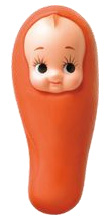
It must be noted that Tarako Kewpie is an offspring of QP Corporation's far more human-looking mascot, which is just a cute baby.

2006-12-02

Happy Mascots: the Hamrins!

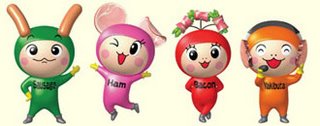
Every time I go to either of the two supermarkets around here, I know there will always be a few characters there to bring a smile to my face. Among these are the Hamrins! -- Happy Mascots of Nippon Ham! In the meat section is a TV screen playing a video on a loop, all day, of these four singing and dancing meat-inspired characters. Fun for me, but presumably dreadful for the supermarket staff that have to work within earshot of the TV.
Sosegita has two sausages on his head like antennas, Hamyuu has two slices of ham on her head like Mickey Mouse ears, Bacoron wears a bouquet of asparagus-bacon rolls, and Yakibeta wears a pair of grilled pork headphones.

The Hamrins may not actually be from earth. They fly in a spaceship named the HAM 86 which is adorned with a giant fork and two knives. What, no chopsticks? Definitely alien.
Of course, they also have a giant robot at their disposal who happens to be called HAM 87. There's a fifth member of the group called Meacoron (from Meatball); I think she's part of the live band because she's not featured in the video.


The instructional video to learn their song's lyrics and their dance moves can be viewed here, among many other things on the Hamrins website.

2006-11-29

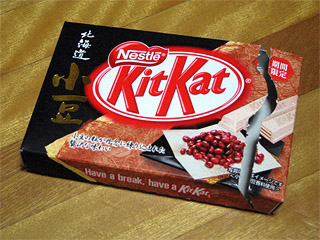
Red Bean flavour KitKat

Here's something we tried last week: Azuki (sweet red bean) flavoured KitKat. The chocolate had a very faint pink colour with dark spots in it, presumably bits of red bean. Unfortunately neither of us were very convinced by the red bean taste -- it just seemed incredibly sweet. I must admit that I found the Azuki bean ice cream I had tried earlier far too sweet as well, to the point where I couldn't actually eat it.

Top marks for this lovely KitKat packaging with its gold lettering, though.

More about Azuki beans on good ol' wikipedia.