videogamesartist.com

visit videogamesartist.com
Showing posts with label life in Japan. Show all posts

2007-09-25

A day at the Sumo

Last week Monday we attended the sumo tournament at the Kokugikan, the sumo arena in Tokyo. It was the 9th day of the two-week tournament held each year in September.
The Kokugikan arena around noon. The bouts start from 9am, but most of the crowd arrives at 2:30pm when the professionals take the stage.
Referees are barefoot during the lower-ranked bouts.

The ritual foot stomping is said to increase strength and squash bad spirits.

The initial lunge.
One of the few short ceremonies held before the top ranking wrestlers start their bouts.

Companies that sponsor the prize money for this bout are allowed to advertise on these banners before the bout starts.

Many bouts are over in a matter of seconds, but in this one the two wrestlers were locked in a battle that seemed to last for minutes.


The final bout of the day followed by the "bow dance" closing ceremony.

2007-08-27

Koenji Awaodori dance festival


The summer festivals continue and this weekend we visited the Awaodori dance festival in Koenji, Tokyo. According to the official website it is the second largest Awaodori festival in the country, at which a staggering 12,000 dancers perform on two evenings. As expected, there were large crowds, but it wasn't too difficult to find a good spot to view the parade from, and the atmosphere was fantastic.


Saving the best for last:

2007-08-08

Matsuri in Asagaya

This weekend we visited a street festival in Asagaya. Asagaya has a quite long glass-covered shopping street that takes a good 10 minutes to traverse on a normal day. As you can see by the crowd below, this was no normal day! The entire length of the street was heavily decorated with lanterns, banners and large paper mache cartoon figures. There were a handful of videogame characters, but they were relatively poorly made compared to this pink bundle of joy.
This is a very common sight at a matsuri. Using a paper "net", kids try to scoop goldfish from a large tank to take home. The paper easily rips when wet, so they must continue to try using the edges of the paper.

Finally! I got to see some stag- and rhino beetles on sale. These wrestling beasts are summer pets for Japanese kids. Admittedly it's difficult to see, but there's a big one feeding at the front, just to the left of the metal ring.

Also on sale were this singing Long-horned Grasshopper, hermit crabs, white salamanders, turtles and crickets.

Of course no street festival is complete without excessive amounts of food. Here scallops and squid-on-a-stick are being sold.

2007-04-06

Hanami at night

Cherry blossom fever continues. Yesterday evening we went to see the cherry blossoms lit up along the Nogawa river. The event was started eleven years ago with the lighting up of a single tree.

Sakura along the Nogawa
Against a black sky, the white trees look even more surreal and make for a somewhat tricky camera subject...Click on any of the images for a larger view, or here to see a video.

Crowd pleaser
The lights are only set up for one night, and only three hours, so it draws quite a crowd. Police were on the scene to tell people to move along.

White trees black sky

2007-03-28

Bargain hunting in Tokyo

After spending nearly 6 months rent all at once but before even moving into your utterly empty flat, you won't be very much in the mood to go spending much more on furnishing the place. Not only will you need to get your own furniture, you'll also need to bring your own fridge, gas cooker and washing machine.

Luckily, there are some real bargains to be found at this stage.

Second hand goods stores are usually quite depressing places; they tend to be disorganised, and stuffed with too much of that porcelain tat that absolutely nobody wants to buy. The
Treasure Factory does just about everything to not make itself look like a second hand goods store. It's clean, well-lit, items are properly categorized and prices are clearly labelled. Six-month warranties are given on larger purchases such as refrigerators, cookers and washing machines, which clearly have been serviced and thoroughly cleaned. The year in which they were manufactured is also clearly stated, so you know exactly how old the item is you are buying. But best of all are the prices - one can really find bargains here.
The whole recycling marketplace in Japan is quite big, with the Book-Off franchise spin-off Hard-Off being the largest chain.
Book-Off is an enormous (and now even international) chain of second hand book sellers that you'll find everywhere in Japan, but from I've seen their prices on second hand games are hardly discounted. I've not been to the ridiculously named Hard-Off so I can't comment on their prices.

For really low prices, there's no beating the shop in your local recycling center. These are dotted throughout Tokyo and can be spotted from a great distance as they all seem to have a tall, white chimney. The city will pick up, clean, repair and put on sale the unwanted goods they consider to be sell-able. Electronic goods and appliances aren't sold here. In some places they will even deliver any purchases to your house for a fee. Here you can also buy unclaimed bicycles that were parked in no-parking zones, fully repaired, for about 6,500 yen.

If you're out buying second hand goods, why not help another foreigner who is leaving the country get rid of his or her stuff? Sayonara sales, as they are called, are happening all the time and you can find them listed in either the paper or online version of the
Tokyo Notice Board. Among other things, we picked up a good sized fridge, only 1 year old, for a mere 12,000 yen from someone. Several sellers gave us free stuff as they were so desperate to clear everything out before their departure.

So what first seemed like an immensely expensive task turned out to be not so bad after all.

We didn't end up buying everything second hand, and I think we were able to furnish the entire flat (+ buy a bicycle) for the equivalent of about 2 weeks rent. With that out of the way, I'm in the mood for spending again.

2007-03-15

Along the Zempukujigawa

Through Suginami runs the Zempukujigawa river, along which we cycled some last weekend. Part of the river is surrounded by the Zempukujigawa Green Belt, which consists of a number of parks and recreational areas.

Cherry blossoms are making headlines in the news again. A computer glitch at the Meteorological Agency supposedly was the cause of the incorrect forecasts of the "official" cherry blossom season. Just so you know, in Tokyo the blossoms are now expected to open around March 23 instead of the original prediction of March 18. This tree, and several others seemed happy with an earlier date, though.


The utterly cute Children's Traffic Park (1-22-13, Naritanishi, Suginami) looks like a great place for kids to learn to ride a bike and the traffic rules. Bicycles, tricycles and pedal cars can be rented and ridden around this miniature town, with low traffic signs and signals. There are even pedal cars for adults in which the very young kids can ride along. It wouldn't surprise me if the rental is free, but we didn't ask. There's also a playground in the park (and many more elsewhere along the river) and an old locomotive.


The Omiya Hachimangu shrine (2-3-1, Omiya, Suginami) is a fairly large shrine that is said to have been built [originally] sometime in the 8th-12th century. There's a fair margin of error for guessing the exact year. The grounds are also quite beautiful, and South of the main building are a large number of portable shrines on display. The sun was setting, so no great photos this time, but I'll certainly be back.

2007-03-11

Finding a flat in Tokyo

Just like anywhere else in the world, finding a flat in Tokyo is a stressful and expensive task. It requires patience yet quick and possibly risky decision-making at times, and seeing all the great properties just outside budget is horribly depressing. To be honest, I don't even like writing about the process, re-living some of the stress, but here goes. (There's a lot to cover, so the writing's a bit sloppy - apologies in advance).

Letting/Estate/Property/Realty agents, whatever you call them depends on where you are from, can often be found near the train stations for the area you wish to look in. They are easily recognized by the numerous cards with floor plans and exterior photos. These cards a fairly comprehensive and contain lots of the information you're after: size classification, actual size in square meters, a quite detailed floor plan, number of minutes walking from the station(s), property age, rent per month and (most of the) additional payments required.
The agent will have many more available to look at inside, and if you are somewhat picky like we are, you are quite likely to look at hundreds of these before going to see any flat on the inside.

Size classification: Properties are labelled with one of the following codes for quick categorisation. They'll give you a pretty good indication of size, and apart from your budget you'll be asked which kind of flat you're after.

1K (One Kitchen): A studio flat, one room with open kitchen inside.
1DK (One Dining Kitchen): Practically the same, just slightly bigger.
1LDK (One Living Dining Kitchen): One combined living/dining room with open kitchen, and a seperate bedroom.
2LDK (Two Living Dining Kitchen): The same, but with two seperate bedrooms.
The list goes on, obviously, with 3LDK, 4LDK, etc.
One thing you soon notice is that having a seperate kitchen in a rarity in this country. When it's there, it will be indicated with an "S" for Separate somewhere in the label, but you'll rarely come across it.

Actual size in square meters & Detailed floor plan: With the last property agents I've had to deal with being in London, I find these two bits of information a luxury.

Most flats in Japan are very small, so it's good to be able to check if the layout is a little clever. Personally, I'm not too fond of having the door to the toilet open directly onto the kitchen.

Each room size is given in number of tatami mats, which (in Tokyo) are 180x90cm each. The most common size for a room is 6 tatami. The floor plan also indicates which rooms actually have tatami flooring, easily recognized by the layout pattern drawn in the plan. Most flats have one tatami-floored room, older flats often more, and newer flats are the most likely to not have tatami flooring at all.

Number of minutes walking from the station(s): If multiple stations are within walking distance they will all be listed, the maximum being usually 15 minutes. The further the flat is from the station, the lower the price is likely to be.

Property age: While the average lifespan of a building in Europe is 50 years, in Japan it is closer to 20 years. A property older than 10 years is considered quite old, and the rent is likely to be lower than that of a newer flat.

Rent per month: This figure is definitive, unlike in the UK where a potential tenant can make an offer on the month's rent.

And finally, listed in numbers x monthly rent, there's the deposit and "gift money". The deposit is usually 1-2 months, and can be expected to be refunded when you end your tenancy.
The "gift money" however is another matter. As the name indicates, this is a "gift" from the tenant to the landlord, which you pay out of thanks for him letting you rent his property. This isn't a requirement for all properties, but this being the equivalent of one or two months rent are equally common.

The hidden costs are revealed later, once you've seen and/or decided which place you want to rent. The property agent takes another month's rent for their services, there's the key money (cost of getting a new lock installed), insurance, and if applicable, a building service charge and additional rent for a car parking spot.

After sifting through the cards an agent will take you to a limited number of flats. Depending on the distance between the flats you are seeing, you may be riding the train with the agent instead of being driven around by car.

We made our decision quite fast, after seeing only four properties on the inside. That in itself made us question if we hadn't decided too quickly (more stress). The flat we'd chosen unfortunately required 2 months deposit and 2 months "gift money", but at least we no longer would have to look around any more. By this time we'd spent many days looking at floor plans online, checking their location in Google Earth and had visited several property agents already.

Once you decide, you need to present a Guarantor - someone who, in the event of an emergency would be able to pay your rent. The ideal candidate for that is Japanese man with a steady job. My brother in law was kind enough to fulfill this formality. Before we could move in though, the landlord would still have to approve of a foreigner without a full-time contract living on his property. For a friend of mine who lives here that has been reason enough to be rejected twice from properties he wanted to rent. I guess we got lucky then, because after a few weeks we got the approval before me even having started work, and my wife wasn't working at the time either.

So, if you want to rent in Tokyo, be willing to cough up up to 6 months rent before you can move into your pricey, cozy and utterly empty flat. There will be no furniture, fridge, cooker, washing machine or bed in it. I'll give some tips on how to get those dirt cheap in an upcoming post.

2007-01-02

Seal of approval

When settling in Japan, you will find that there are certain things you will truly need you didn't expect. One such thing is a personal seal, roughly the size of a AA battery, officially called an inkan or more commonly referred to as a hanko ("stamp").

The inkan serves the same purpose as a signature does in the West; it is used to mark your agreement, and so all Japanese have their own inkan. Many banks require you to have a inkan, and it is used for signing contracts and official documents. Before buying real estate, a car or a house one must have their inkan registered at the town hall. A registered inkan is known as a jitsuin. For foreigners the jitsuin must contain their surname, which may be written in katakana or the Roman alphabet (romaji).

Inkans for common Japanese names can be bought for as little as 105 yen, but foreigners will have to get one custom made and that will cost around 4000 yen. Thankfully, shops where you can get them made are plentiful, and there also plenty of suppliers online. These inkans are clearly a big business here, and customers can choose from an enormous range of sizes, materials, fonts and carrying cases. Check out the extensive website of hankoya.com, with its sub-domains for women's and titanium inkans.

A few weeks ago I was bought my inkan as a birthday gift. I decided to have my last name put on it in katakana. My last name is quite long, so the resulting inkan has some of the narrowest katakana I've ever seen crammed into the 13.5mm diameter. I've not actually used it yet, but I'll be opening a bank account in the near future and of course there's the job contract I look forward to signing - I mean, stamping soon.

2007-01-01

Happy New Year!

...or akemashite omedetou: "congratulations on the beginning of a New Year"!

New Year is one of the most important holidays in Japan. Like Christmas in the West, celebrations are a mixture of religion, visiting family, watching TV, gift giving and of course lots of food.

Following a tradition dating back to the Edo-period (17th-19th century), on New Year's Eve we ate Toshikoshi soba ("Going into the New Year" buckwheat noodles), and on New Year's Day we had Mochi. We didn't watch the yearly Kohaku Uta Gassen on TV, a 5-hour singing "contest" featuring countless Japanese musicians of past and recent fame. Right now however, we're watching actor/director Takeshi Kitano doing some tap-dancing on another famous New Year TV show. This afternoon we visited a nearby shrine, where we made our prayers for the year ahead. This year is the Year of the Boar according to the Chinese zodiac, in case you're wondering what it's doing in the picture above.

Happy New Year!

2006-12-18

Mochitsuki

Yesterday my father-in-law, an active member in the local community, took me to a local rice cake making event. The rice cake is called mochi, the traditional way of making it is called mochitsuki. About 80 people had turned up for this year's event, which took place outside a community center a few blocks away from our house. Mochitsuki involves pounding rice into paste using large wooden mallets, so it's fun for the whole family.

The rice is first steamed (not boiled) above fires. It is then put into a mortar, where it is first kneaded and subsequently pounded into a thick paste using big wooden mallets. The rice is kneaned first to stop the rice from flying about when it is pounded. While the rice is being pounded, another person wets and turns the rice between each hit. Although you're encouraged to keep a fairly high rhythm to this, I found it quite difficult to do so with the kind old lady sticking her hand in the mortar every time!

After the pounding it is cut and molded into shapes and is eaten with either sweet or savoury flavourings. I tried two sweet varieties (one in red bean sauce, the other with toasted soybean flour) and one savoury (mochi with fine chopped radish). Mochi is incredibly chewy so it took me ages to finish the portion I'd been given. I much preferred the sweet variety.

Traditionally mochi is food for the Japanese New Year. Because it can be kept for a very long time, it would be made just prior to the new year and could be consumed throughout the winter. It can be further prepared in many different ways. For example, it can be added to soup or small pieces of dried mochi can be deep fried to make a crispy snack.

After the mochitsuki, I was invited to join the organisers in a lunch with beer and shōchū, which is a kind of Japanese vodka that's quite nice to drink with hot water.

Later that (birth)day, I took the family out for dinner at an Izakaya (Japanese "tapas-bar").

Read more about Mochi on wikipedia.

2006-11-28

Akiba Robot Fair 2006

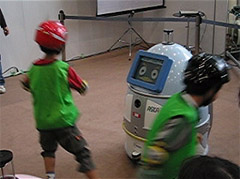
Earlier this month, me and a friend went to the Akiba Robot Fair in Akihabara. Akihabara is also known as "Electric Town" and is famed for its enormous electronics shops. It has also evolved into a center for geek ("otaku") culture with its many games- and anime shops, and more recently the Maid Cafés. The last time I was in Akihabara I don't think these even existed, now you are greeted by a number of maids promoting their cafés as soon as you come out of the station (on a busy Saturday at least).

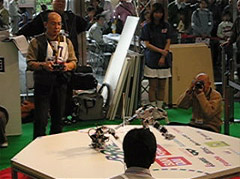
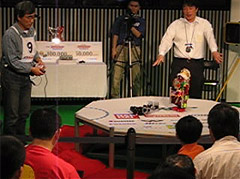
The robot fair itself, located in a shiny new building behind the station, featured robot football and battle events, build-your-own-robot workshops, special demonstrations and of course a display of various robots.


Click on the images below to see the videos I took at the fair.

A creepily realistic robot woman.

Kids confuse a penguin robot.

Robot Battle: Humiliation!

A typical Robot Battle.


You can read another blog post about the Akiba Robot Fair here.

2006-11-16

Autumn Fire Prevention Week

Yesterday was the last day of Autumn Fire Prevention Week in Japan. The week starts annually on November 9th, as a reminder to dial 11-9 in case of a fire. The local firestation (shoubousho) was open to the public on Sunday, and since it is literally a stone's throw from our house we decided to have a look.

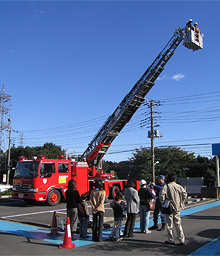
A number of firefighting and rescue operations were on display or being demonstrated. We saw a demonstration of a portable defibrillator which talks the user through the steps on how to use it, firemen sliding a stretcher and themselves down a rope, and a fireman abseiling down the side of a building. Children could wield (water-based) fire extinguishers and watch animations -- from what I could see, it just looked like Pokemon to me, though. We saw a young child crying its eyes out after its parents had put it in an oversized fireman's outfit, and were trying to take a picture of it.
The highlight however was the chance to be lifted up an extending crane to about 30m high (shown here about halfway up).

For me, Autumn Fire Prevention Week has done its job - I've since had a look at the website of the
Tokyo Fire Department (English page) and know what to do in case of fire: run down the road to the shoubousho! Or dial 119.

2006-11-13

PS3 Launch in Japan

I suppose I should write something about the Japanese PlayStation 3 launch, seeing as I'm a games developer who's in Japan.
Of course, I didn't carry out my devilish plan to try to buy one here and double/triple my money by selling it on eBay to someone who really wants one. With some luck that could've worked, if also I had the energy to queue all night, but I consider myself too old for that kind of thing.
Having just seen an item on TV on the launch, I have no regrets. Twelve employees of the TV show were sent on a mission to buy a PS3, and began queueing 24 hours before the launch which would be at 7am on Saturday. The report showed sleeping people on the streets, sped-up shots of the queues hundreds of people long, and a manic stampede across a street and into a large shop, with security looking utterly helpless. Out of the twelve TV employees five managed to buy a PS3. A good first-hand account of the events can be found
here.

2006-11-06

Quick first post

OK, so two months after arriving in Japan I finally sit down and start writing my weblog. What's been keeping me so busy? I will try to answer that in a few upcoming posts.
First up, I'll be documenting my search for a job here. Hopefully, that won't last very long and I'll be able to just join the ranks of the many "Hey-I'm-in-Japan!"-bloggers.
Read on!